



Before You Buy a Smart Home, Ask This One Question

Before you buy a smart thermostat, ask a different question.
Before you buy smart lights, ask a different question.
Before you install motorized curtains, smart locks, sensors, cameras, or voice assistants, stop.
Ask yourself:
What do I want my home to do for me?
What do I want my home to do for me?

The Smart Home Trap: Buying Devices Instead of Designing Experiences
Walk into almost any electronics store and you'll find hundreds of smart products.
Smart bulbs.
Smart plugs.
Smart speakers.
Smart thermostats.
Smart locks.
Smart cameras.
Smart curtains.
Smart TVs.
Each product promises to make your life easier.
And individually, many of them can.
But there's a problem.
You can own 50 smart devices and still have a home that doesn't feel intelligent.
Why?
Because connecting devices isn't the same as creating an intelligent environment.
A home with ten different apps isn't necessarily smarter than a traditional home.
It may simply be more complicated.
Luxury Smart Home Automation Starts With Experiences
Imagine coming home after a long day.
You don't want to think about technology.
You want the house to know that you're home.
The entrance lights activate.
The temperature reaches your preferred comfort level.
The curtains adjust.
The security system changes mode.
Your favorite lighting scene becomes available.
Music begins playing softly.
Nothing requires five different apps.
Nothing requires you to walk around pressing buttons.
The house simply becomes ready.
That's the difference between owning smart devices and living in a smart home.
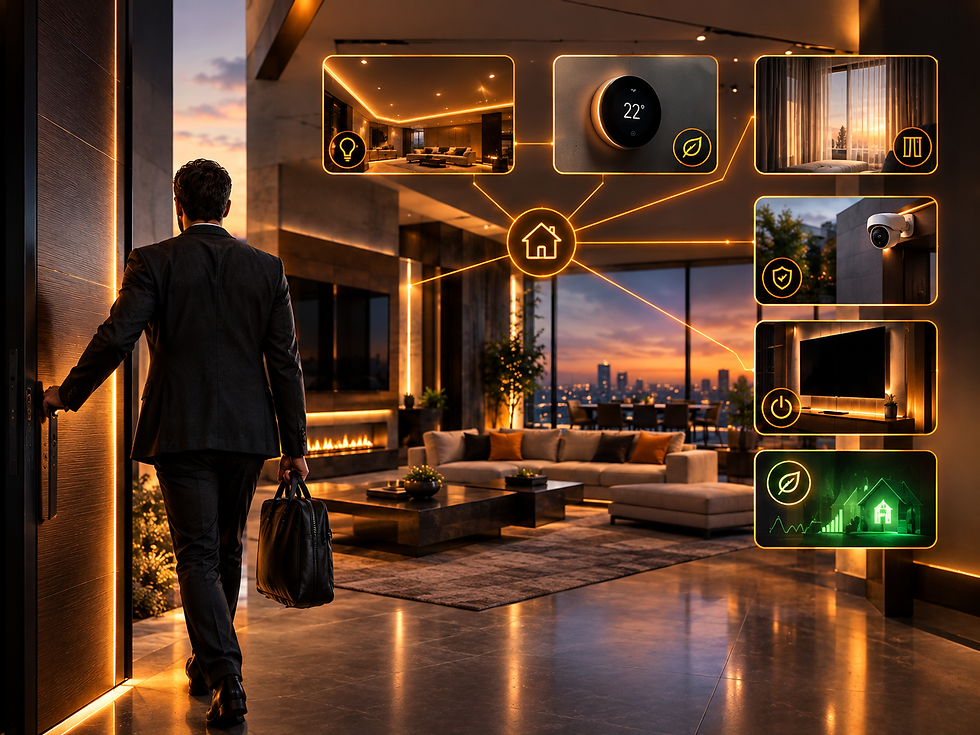
What Should Your Home Do When You Arrive?
This is the first experience worth designing.
The Arrival Scene
Imagine approaching your home in the evening.
The system knows the property is transitioning from away mode.
The entrance pathway illuminates.
Selected interior lights activate.
The climate system begins preparing the occupied zones.
Security transitions appropriately.
Curtains respond according to the time of day.
Your preferred atmosphere is created before you've even reached the living room.
You didn't operate six systems.
You triggered one experience.
That's intelligent automation.
What Should Your Home Do When You Leave?
Now reverse the experience.
You close the door.
Instead of wondering:
"Did I turn everything off?"
the home handles it.
Selected lights switch off.
Unnecessary climate zones adjust.
Curtains respond according to programmed conditions.
Security activates.
Selected equipment can be switched off.
The home transitions into an energy-conscious state.
One action.
Multiple coordinated responses.
That's where automation starts becoming valuable.

What Should Happen When You Say "Good Night"?
This is where the difference between devices and experiences becomes even clearer.
A traditional smart home might allow you to control your bedroom light from your phone.
A properly designed automation system can create a Good Night Scene.
One command can coordinate:
Lighting
Climate
Curtains
Security
Selected appliances
Access systems
The experience isn't:
"Control six devices."
It's:
"Prepare the house for the night."
That distinction is at the heart of sophisticated Smart Home Automation.
Ekinex KNX: When the Interface Becomes Part of the Architecture
Once you've designed the experiences, another question appears:
How should you interact with the home?
This is where Ekinex KNX becomes particularly interesting.
In a premium residence, technology shouldn't destroy the design of the interior.
A wall covered with generic switches can undermine an otherwise carefully designed space.
Ekinex approaches the control interface differently.
The interface becomes part of the architecture.
Minimal.
Refined.
Tactile.
Intentional.
The technology remains powerful, but the visual experience remains sophisticated.
Because in a luxury home, the control interface isn't just a technical component.
You touch it every day.
You see it every day.
It should feel like it belongs.

The Best Smart Home Technology Doesn't Ask for Your Attention
Think about the best services in a luxury hotel.
You don't see everything happening behind the scenes.
You simply experience the result.
The room is comfortable.
The lighting feels right.
The environment feels calm.
Your needs are anticipated.
The best Luxury Smart Home Automation follows the same philosophy.
Technology works quietly in the background.
You interact with it when you want to.
But you don't have to think about it constantly.

Stop Asking "What Can I Control?"
Ask:
What Can My Home Handle for Me?
This is the mindset shift.
Traditional automation conversations often begin with:
"What can I control?"
A more intelligent conversation begins with:
"What should happen automatically?"
Consider these examples.
Instead of:
"I want smart lights."
Ask:
"How should my lighting behave throughout the day?"
Instead of:
"I want smart curtains."
Ask:
"How should my home respond to sunlight and privacy?"
Instead of:
"I want a smart thermostat."
Ask:
"How should my home manage comfort when rooms are occupied or empty?"
Instead of:
"I want a smart security system."
Ask:
"How should my home behave when I'm away?"
The second question leads to better automation.
Five Experiences Every Luxury Smart Home Should Consider
Before choosing products, think about experiences.
1. Arrival
What should happen when you come home?
2. Departure
What should happen when everyone leaves?
3. Good Morning
How should the home transition from night to day?
4. Relax
How should lighting, climate, shading, and entertainment respond when you want to unwind?
5. Good Night
How should the entire property prepare itself for sleep and security?
These scenes can become the foundation of your automation strategy.
A Smart Home Should Understand Context
A truly intelligent environment doesn't only know what you commanded.
It understands context.
Time.
Occupancy.
Daylight.
Temperature.
Weather.
Security status.
Room usage.
User preferences.
These factors can influence how the building behaves.
For example, the same lighting command might produce a different result at 2 PM than it does at 10 PM.
A smart home shouldn't simply execute commands.
It should respond intelligently to circumstances.
The Hidden Luxury: Fewer Decisions
Modern life already requires thousands of decisions.
What to eat.
Where to go.
What to work on.
What to buy.
What to schedule.
Your home doesn't need to add more.
Automation can remove unnecessary decisions from everyday life.
Instead of remembering to adjust everything manually, the home can handle routine actions according to predefined logic and preferences.
That's a different definition of luxury.
Not more buttons.
Fewer things to think about.
Smart Home Automation Should Be Designed Around Your Life
Every family is different.
A family with young children may prioritize security and nighttime routines.
A frequent traveler may prioritize remote monitoring and away scenarios.
Someone who entertains often may prioritize lighting, shading, climate, and entertainment scenes.
A homeowner focused on sustainability may prioritize energy monitoring and intelligent control.
There is no single perfect automation experience.
The system should be designed around the people living in the property.

Why KNX Changes the Conversation
For premium residential projects, the question shouldn't only be:
"Which smart device should I buy?"
It should be:
"How should the entire home communicate?"
KNX provides a professional building automation framework that can bring different systems into a coordinated environment.
Lighting.
Climate.
Shading.
Security.
Access.
Energy.
Entertainment.
Instead of treating each system as a separate island, automation can be designed as an ecosystem.
And that's particularly important when you're building a luxury property that you expect to enjoy for many years.
The Smart Home You Build Today Shouldn't Trap You Tomorrow
Technology changes quickly.
The devices you buy today may not be the devices you want five years from now.
That's why the infrastructure behind a smart home matters.
A sophisticated automation strategy should consider:
Scalability
Integration
Future expansion
Maintenance
Interoperability
User experience
Long-term reliability
The goal isn't to create the most impressive smart home today.
It's to create a home that can continue evolving.
Don't Design 50 Controls. Design 5 Experiences.
This is perhaps the most important principle.
You don't need to think:
"Which button controls this light?"
Think:
Arrival.
Departure.
Morning.
Relax.
Night.
Behind each experience, dozens of individual automation actions can happen.
But the homeowner experiences simplicity.
That is the difference between complexity behind the scenes and simplicity in front of you.
The Question You Should Ask Before Buying Anything
So before you purchase your first smart device, don't ask:
"Is this device smart?"
Ask:
"What should my home do for me?"
That question changes everything.
It moves you from shopping for gadgets to designing an experience.
From individual devices to an ecosystem.
From manual control to intelligent automation.
From technology you can see to technology you simply experience.
Your Home Should Work Around You
A luxury home shouldn't make you adapt to technology.
Technology should adapt to the way you live.
The lights should support your routines.
The climate should support your comfort.
The shading should respond to the environment.
Security should support your peace of mind.
Entertainment should be effortless.
And the entire experience should feel natural.
That's what Luxury Smart Home Automation should ultimately deliver.
Not more technology.
A better way to live.
Ready to Design Your Smart Home Around Your Life?
At Teknetic, we don't start with a list of devices.
We start with your lifestyle.
How do you arrive home?
How do you leave?
How do you relax?
How do you entertain?
What should happen automatically?
What should remain under your control?
From professional KNX automation to elegant Ekinex KNX interfaces, we can help transform those answers into a connected, intelligent, and beautifully integrated home.


Comments