



From Pyramids to Smart Buildings:What Ancient Egyptian Architects Can Teach Us About Future Automation

For over 4,500 years, the pyramids have stood as symbols of innovation, precision, and human ingenuity.

Long before artificial intelligence, IoT devices, and smart automation systems existed, Ancient Egyptian architects were already solving some of the same challenges modern building designers face today:
Energy efficiency
Environmental adaptation
Human comfort
Operational longevity
Resource optimization
Scalable construction
While separated by millennia, the philosophy behind the world's most iconic structures shares remarkable similarities with the goals of today's intelligent buildings.
The tools have changed.
The vision has not.
The Future of Smart Building Automation: From Pyramids to Intelligent Buildings
When people think of smart buildings, they imagine sensors, touchscreens, and automated systems.
Yet true intelligence in architecture has never been about technology alone.
It has always been about designing spaces that work in harmony with people and their environment.
Ancient Egyptian builders understood this exceptionally well.
The pyramids, temples, and monumental structures they created were engineered to withstand extreme environmental conditions while maintaining functionality for generations.
In many ways, they were designing for the future.
Today's smart building designers are doing exactly the same thing.

The Long-Term Benefits of Smart Building Automation
Modern construction often focuses on immediate needs.
Ancient Egyptian architecture focused on permanence.
The Great Pyramid was not designed to perform for ten years.
It was designed to endure for thousands.
This mindset offers an important lesson for modern automation projects.
When implementing smart technologies, building owners should ask:
Will this system still serve its purpose twenty years from now?
This is why future-proof automation standards such as KNX have become increasingly important.
Like the master builders of Ancient Egypt, today's smartest projects prioritize longevity over short-term trends.
A truly intelligent building is not one that simply uses technology.
It is one that can evolve with technology.
The Ancient Art of Environmental Intelligence
Without modern air conditioning, Egyptian architects developed ingenious methods to manage heat and sunlight.
Massive stone walls provided thermal stability.
Strategic orientations reduced solar gain.
Courtyards encouraged natural airflow.
Shaded spaces improved comfort during extreme temperatures.
These principles represent an early form of environmental intelligence.
Today, smart automation expands upon the same philosophy.
Modern buildings can:
Adjust cooling based on occupancy
Automatically control shading systems
Optimize natural daylight
Reduce unnecessary energy consumption
Monitor environmental conditions in real time
The objective remains unchanged:
Create comfortable spaces while using resources efficiently.

The Pyramid Principle: Every Element Works Together
One reason the pyramids continue to fascinate engineers is the extraordinary coordination of their components.
Every stone had a purpose.
Every angle mattered.
Every element contributed to the stability of the structure.
Smart buildings operate in a similar way.
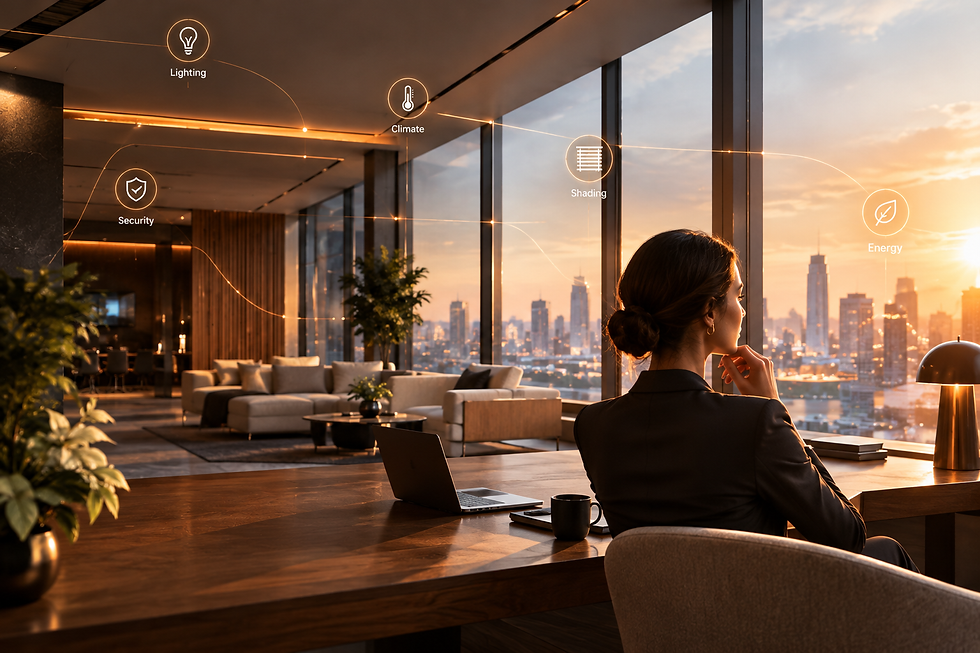
Lighting should not function independently from climate control.
Security systems should communicate with occupancy sensors.
Energy management should interact with shading and HVAC systems.
The most intelligent buildings are not collections of separate technologies.
They are integrated ecosystems.
Automation succeeds when every component works together toward a common goal.
Data Is the New Stone
Ancient builders relied on measurements, astronomy, mathematics, and meticulous planning.
Today, data has become the foundational material of intelligent buildings.
Sensors continuously collect information about:
Occupancy
Temperature
Humidity
Energy consumption
Lighting conditions
Indoor air quality
This data allows buildings to respond dynamically to changing conditions.
The difference between ancient and modern architecture is not the need for information.
It is the speed at which information can be acted upon.
Where ancient builders calculated manually, smart buildings calculate continuously.
Sustainability: An Ancient Idea with Modern Technology
Sustainability may seem like a modern concept, but resource efficiency has always been essential to successful civilizations.
Ancient Egyptian society depended on careful management of materials, labor, water, and energy.
Today's buildings face similar challenges.
Rising energy costs and environmental concerns are driving demand for smarter infrastructure.
Automation enables buildings to:
Reduce energy waste
Improve operational efficiency
Extend equipment lifespan
Lower carbon emissions
Support sustainability goals
In this sense, smart buildings are not introducing a new idea.
They are applying timeless principles with modern tools.
The Future Pharaoh's Palace
Imagine a luxury residence inspired by Ancient Egyptian design principles but powered by modern automation.
As the sun rises:
Curtains open automatically.
Indoor temperatures adjust naturally.
Lighting adapts to daylight conditions.
Throughout the day:
Energy systems optimize consumption.
Security systems monitor activity.
Climate control responds to occupancy.
At night:
Architectural lighting highlights design features.
Smart shading preserves privacy.
The building enters an energy-efficient mode.
The result is not a futuristic fantasy.
It is already possible today.
The difference is that intelligence is no longer carved into stone.
It is embedded within the building itself.

What Modern Architects Can Learn from Ancient Egypt
The greatest lesson from Ancient Egyptian architecture is surprisingly simple:
Technology changes. Principles endure.
Successful buildings have always shared common characteristics:
Adaptability
Efficiency
Durability
Human-centered design
Environmental awareness
Smart automation is simply the latest chapter in humanity's ongoing effort to create better spaces.
The future belongs to buildings that do more than shelter people.
The future belongs to buildings that understand them.
Conclusion
The pyramids remain one of humanity's greatest engineering achievements because they were designed with vision, precision, and a deep understanding of their environment.
Today's smart buildings pursue the same goals through different means.
By combining intelligent automation, integrated systems, and sustainable design, modern architecture is evolving into something remarkable:
Buildings that can sense, respond, adapt, and optimize themselves.
From the ancient builders who shaped the desert skyline to the engineers designing tomorrow's intelligent spaces, one principle remains unchanged:
Great architecture is never just about construction. It's about creating structures that stand the test of time.
And in the age of automation, that future is smarter than ever.


Comments