


The $10 Million Mistake: Why Luxury Projects Get Smart Automation Wrong Before Construction Begins

A luxury property can take years to imagine, design, approve, and build.
Millions can be invested in architecture.
Millions more in interiors, landscaping, lighting, furniture, materials, and finishes.
The marble is carefully selected.
The windows are positioned perfectly.
The lighting has been designed down to the smallest detail.
The kitchen is customized.
The furniture is commissioned.
And then someone asks:
"Where are we putting the smart home controls?"
Suddenly, the switches don't fit.
The sensors weren't planned.
The wiring needs to change.
The electrical drawings have to be revised.
The interior designer doesn't like the proposed keypads.
The automation system can't communicate with another system.
And the project team discovers something that should have been considered much earlier:
Smart automation isn't something you simply install at the end of a luxury project.
It should be part of the project from the beginning.
Because when automation is treated as an afterthought, the most expensive mistake isn't necessarily the equipment.
It's the compromise.

Luxury Home Automation Should Begin Before the First Wall Is Built
One of the biggest misconceptions about Luxury Home Automation is that automation starts when someone chooses the switches.
It doesn't.
It starts much earlier.
It begins when the architect starts thinking about how people will experience the space.
Where will natural light enter?
How will rooms transition throughout the day?
How will privacy be managed?
How will temperature change?
How will lighting respond to different activities?
How will security work when the property is occupied—or empty?
How should the building behave when nobody is there?
These questions belong in the design process.
Not during the final installation phase.

The Hidden Cost of Designing Automation Too Late
Imagine a luxury villa nearing completion.
The walls are finished.
The ceilings are closed.
The interior finishes have been installed.
Then the automation requirements arrive.
Perhaps additional sensors are required.
Perhaps the original electrical plan doesn't accommodate the desired control architecture.
Perhaps the client wants motorized curtains that weren't considered.
Perhaps the lighting system needs to communicate with the automation system.
Perhaps the designer wants elegant architectural keypads instead of conventional switches.
Now every change becomes more complicated.
A small decision can trigger a chain reaction involving:
Electrical modifications
Additional wiring
Ceiling access
Wall repairs
Interior redesign
Programming changes
Equipment replacement
Construction delays
The cost isn't just financial.
It's time.
Coordination.
Design compromises.
And frustration.
This is how a project can make a multi-million-dollar investment feel unnecessarily complicated.
The "$10 million mistake" isn't about saying every poorly planned automation project literally costs $10 million.
It's about the mindset:
Why invest millions in creating a beautiful building and then make one of its most important systems an afterthought?

Smart Building Automation Is an Architectural Decision
Automation is often placed under the responsibility of the electrical or technology team.
But modern Smart Building Automation affects architecture, interiors, engineering, operations, and ultimately the human experience.
Consider a simple wall keypad.
It seems insignificant.
But multiply that keypad across:
Bedrooms
Living rooms
Corridors
Bathrooms
Kitchens
Offices
Hotel suites
Meeting rooms
Suddenly, the control interface becomes part of the visual language of the building.
That means the automation conversation belongs at the design table.
With the architect.
With the interior designer.
With the MEP consultant.
With the developer.
And with the automation specialist.
Before construction locks the project into decisions that are expensive to change.

Ekinex KNX: When Automation Becomes Part of the Design
This is where Ekinex KNX introduces an important idea:
What if the automation interface wasn't treated as equipment?
What if it was treated as architecture?
Ekinex brings Italian design thinking into the world of KNX building automation, creating interfaces designed to complement sophisticated interiors.
Instead of allowing technology to visually dominate a wall, the objective is to create a control element that feels intentional.
The keypad becomes part of the composition.
The finish can complement the surrounding materials.
The proportions can work with the architectural language.
The technology remains powerful—but visually restrained.
That is particularly important in luxury projects where every detail has been carefully considered.

The Switch Is Small. The Decision Is Not.
A switch may occupy only a few centimeters of wall space.
But the decision surrounding it can influence the entire project.
Should it be:
Minimalist?
Architectural?
Tactile?
Glass?
Metal?
Dark?
Light?
Integrated?
How many buttons should it have?
What should each button control?
Should one touch activate an entire scene?
Should lighting, shading, climate, and entertainment work together?
These are not merely product questions.
They are experience-design questions.
The best automation projects answer them before the first finishing layer is installed.
Don't Design 50 Switches. Design 5 Experiences.
This is one of the biggest opportunities in modern automation.
Traditional thinking says:
"We need a switch for the lights."
Smart thinking asks:
"What should happen when the homeowner arrives?"
Those are completely different approaches.
Imagine an Arrival Scene.
The entrance lighting activates.
The pathway illuminates.
The temperature adjusts.
Selected curtains open.
Security transitions from away mode.
Music becomes available.
The home feels ready.
One experience replaces a collection of individual commands.
Now imagine:
Good Morning
The bedroom gradually brightens.
Shading adjusts.
Climate transitions toward the preferred daytime temperature.
Relax
Lighting becomes warmer.
Curtains adjust.
Entertainment becomes available.
Temperature shifts toward evening comfort.
Good Night
Selected lights switch off.
Security activates.
Curtains close.
Climate enters night mode.
The home doesn't become "smart" because it has more switches.
It becomes smart because multiple systems understand the same moment.

The Developer's Question: What Happens After Handover?
A luxury development doesn't end when construction finishes.
The building may operate for decades.
That creates another important question:
Can the automation system evolve with the property?
Technology changes quickly.
Consumer devices come and go.
New interfaces appear.
New energy systems emerge.
AI becomes increasingly capable.
Owners change.
Tenants change.
Buildings change.
A future-ready automation strategy should therefore consider:
Scalability
Interoperability
Long-term maintenance
Upgradeability
System architecture
Integration
User experience
This is one reason open standards such as KNX are important when planning professional automation infrastructure.
The objective isn't simply to create an impressive building today.
It's to create a building that can continue evolving tomorrow.
The Most Expensive Automation Mistake Isn't Buying the Wrong Product
It is designing the project around the wrong philosophy.
A project can have expensive devices and still deliver a poor experience.
It can have dozens of smart products and still require constant manual interaction.
It can have beautiful switches and still lack meaningful automation.
Technology alone doesn't create intelligence.
Integration does.
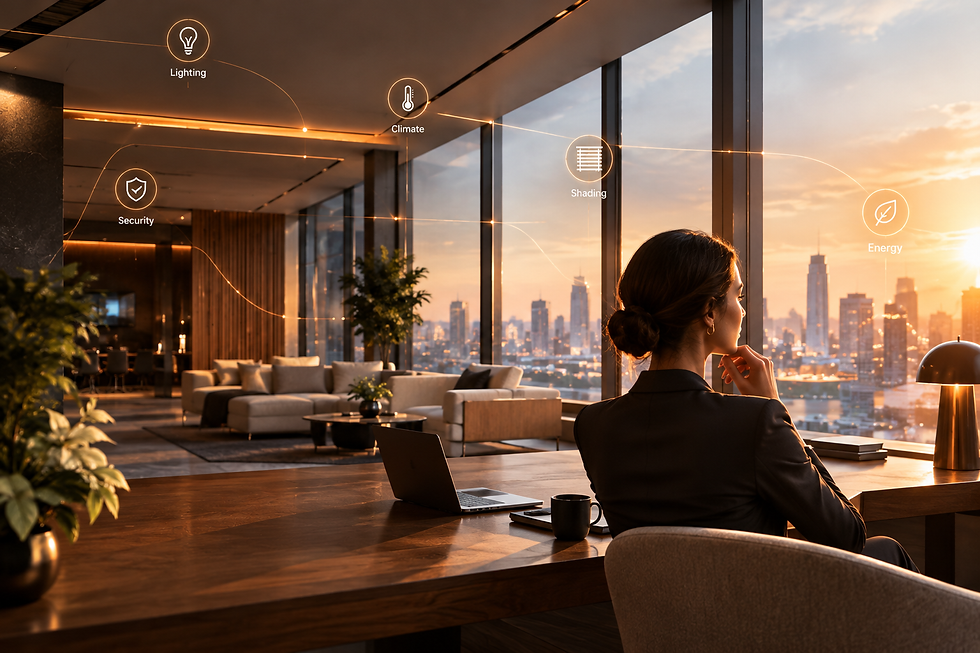
A successful automation project considers the entire ecosystem:
Lighting.
Climate.
Shading.
Security.
Access.
Energy.
Entertainment.
Occupancy.
Scenes.
And the people using the building.
Why Architects Should Be Involved Earlier
For architects and interior designers, early involvement creates an enormous advantage.
Instead of asking:
Where can we fit the automation equipment?
the design team can ask:
How can automation strengthen the architectural concept?
That changes everything.
Sensors can be positioned intentionally.
Interfaces can be selected to complement finishes.
Lighting can be designed around automated scenes.
Shading can become part of the environmental strategy.
HVAC can work with occupancy.
Technology can disappear into the architecture.
The result isn't a building with automation added to it.
It's a building designed with automation in mind.

Why Developers Should Care About the Automation Strategy
For developers, automation is not simply a technology expense.
It can become part of the property's value proposition.
A well-designed smart property can offer:
Differentiation
Stand out in an increasingly competitive luxury market.
Experience
Give buyers or guests something they can immediately feel.
Operational Efficiency
Use automation to manage energy and building systems more intelligently.
Future Readiness
Create infrastructure that can evolve instead of becoming obsolete quickly.
Brand Positioning
Present the development as sophisticated, intelligent, and forward-thinking.
For premium developments, these factors can influence how a property is perceived long after the construction team has left.
The Invisible Infrastructure Behind Visible Luxury
Luxury architecture is about what people see.
Automation is often about what they don't.
Behind a beautifully finished wall may be an infrastructure connecting dozens or hundreds of devices and systems.
The challenge is making that complexity feel simple.
The homeowner shouldn't need to understand the engineering.
The hotel guest shouldn't need to understand the KNX architecture.
The office employee shouldn't need to understand the control logic.
They should simply experience:
Comfort.
Convenience.
Security.
Efficiency.
Control when they want it.
And automation when they don't.
The Five Questions Every Luxury Project Should Ask Before Construction
Before approving the automation strategy, ask:
1. What should the building automate automatically?
Not everything needs manual control.
Identify the repetitive actions that should happen without intervention.
2. How should the building respond to people?
Occupancy, schedules, preferences, and context should influence the environment.
3. Where should technology be visible?
In premium architecture, visibility should be intentional—not accidental.
4. Can the system integrate with other technologies?
Lighting, HVAC, shading, security, access, energy, and entertainment should work as an ecosystem.
5. Can the system evolve?
The building you design today should not become technologically trapped tomorrow.
The Pre-Construction Automation Checklist
Before construction begins, your project should ideally have a clear strategy covering:
Architecture
Control interface locations
Sensor positioning
Equipment spaces
Integration requirements
Lighting
Lighting circuits
Dimming requirements
Scenes
Occupancy control
Climate
HVAC integration
Temperature zones
Occupancy-based control
Shading
Motorized blinds
Curtains
Daylight management
Solar protection
Security
Access control
Intrusion detection
Video integration
Away and night scenarios
Energy
Monitoring
Consumption optimization
Renewable-energy integration where applicable
User Experience
Keypad design
Mobile control
Scenes
Voice interaction where appropriate
Guest and resident interfaces
Future
Scalability
Integration
Maintenance
Upgrade strategy
The earlier these decisions are made, the more naturally automation can become part of the project.
The New Luxury Is Designed Before It Is Installed
The most successful luxury automation projects don't begin with:
"Which smart switch should we buy?"
They begin with:
"How should this building behave?"
That single question changes the entire process.
It moves automation from a product purchase to an architectural strategy.
From switches to experiences.
From devices to ecosystems.
From installation to design.
And from today's technology to tomorrow's possibilities.
Your Building Is Already Being Designed. Is Its Intelligence?
A luxury project can survive a lot of changes during construction.
But the later automation is considered, the more likely it becomes a compromise.
The walls may already be finished.
The ceilings may already be closed.
The electrical infrastructure may already be fixed.
The interior design may already be approved.
At that point, you're no longer designing the ideal automation system.
You're trying to make the existing building accept it.
That's the difference between automation-led design and automation added at the end.
One creates possibilities.
The other creates compromises.
Conclusion:
Don't Add Intelligence to the Building. Design It In.
The next generation of luxury homes, hotels, and commercial properties won't be defined by how many smart devices they contain.
They'll be defined by how naturally everything works together.
The best automation is planned before the walls are finished.
It is considered alongside architecture.
It respects interior design.
It integrates building systems.
It reduces unnecessary interaction.
It creates meaningful experiences.
And when it is done properly, the technology almost disappears.
That is where Luxury Home Automation, Smart Building Automation, KNX, and architectural design meet.
And that is why the most important automation decision may happen long before the first smart device is ever installed.
Don't wait until the walls are finished to make the building intelligent.
Design the intelligence from the beginning.
Ready to Design a Smarter Project?
Whether you're developing a luxury villa, hotel, residential compound, office, or commercial property, automation should be considered from the earliest design stages.
Teknetic works with architects, developers, interior designers, consultants, and property owners to create integrated automation solutions that combine intelligent functionality with sophisticated design.
Planning a new project?
Talk to Teknetic before construction begins.
Let's design the intelligence before we build the walls.


Comments